List of floods marked on the Timeline;
1877-Uig (14th October)
Rain had fallen continuously for 24 hours on the north of the Isle of Skye. With the majority of flood damage affecting Kilmuir estate, owned by a very unpopular landlord, Captain Fraser. The flood waters washed away crops, drowned sheep and swept them into Uig Bay. Part of the graveyard was washed away with skeletons washed out to sea. Many said at the time that it was God’s wrath being acted out on Capt. Fraser, with some lamenting that it was pure bad luck that he was absent at the time.
1829- The Muckle Spate/The Moray Floods. August 3rd, 4th and 27th.
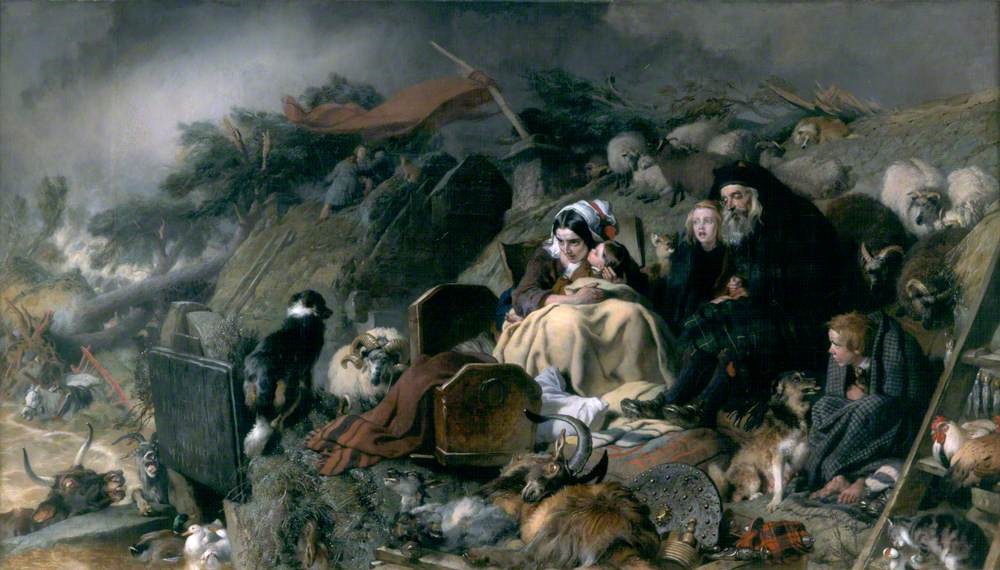
An incredible amount of rain fell across the Grampian Mountains particularly the Moniliath Range which feeds the rivers Nairn, Findhorn, Lossie, Spey and many others. Rivers and lochs rose to levels exceeding those of previously remembered floods and remain unsurpassed to the present day. A Mill was swept away as well as large amounts of agricultural land, homes and bridges some of them recently constructed. This flood is well documented in ‘The Great Moray Floods of 1829’, by Sir Thomas Dick Lauder a local landlord who travelled the area during the flood recording the height of the water at the bridges left standing and making sketches of the devasted landscape. He describes the wonderful escape of a poor woman who was carried off in the flood after trying to cross a burn using two narrow planks; she was swept downstream for half a mile ‘luckily kept floating by the buoyancy her garments.’
There is a famous painting ‘Flood in the Highlands’ in Aberdeen Art Gallery by Edwin Landseer inspired by the disaster.
1794 The Goniel Blast
A severe blizzard known as the Goniel Blast was widely recorded in the Southern Uplands and led to the loss of life of many thousands of sheep and the death of several shepherds in Dumfriesshire. For several days the snow fell so heavily that in some places it was 50feet deep. In the parish of Eskdale Muir alone 4,000 sheep perished.
An effect of the frost was that many of the sheep that died remained fit to eat; the word ‘goniel’ refers to flesh fit to eat though not killed by a butcher. Meat prepared in this way was usually smoked and dried.
1774 Perth Flood
The Tay discharges more fresh water than any other river in Britain, equal to the Thames and the Severn combined. When the snows melt, enormous flows can be released, up to 7 million cubic meters per hour. Perth has suffered 34 recorded floods between 1209/1210 and 1993.The floods of 1774 1nd1814 are the worst ever recorded in Perth and were aggravated by broken ice jamming below Smeaton’s Bridge and forming a high dam. Large sections of Perth including both it’s Inches were flooded.

1694-1702, ‘7 years famine’.
The famine took place prior to the advent of potato cultivation in Scotland and hence there was a great dependence on grain. Poor weather conditions frequently led to severe famine. This period also coincided with the culmination of the Little Ice Age and with colder, wetter, unseasonable and erratic weather conditions, the country experienced, failed harvests, high grain prices, increased disease and mortality rates, economic difficulties and the displacement of people.
1607 The Great Frost
This winter coincided with one of the strongest El Nino events in recent history. According to Mossman ‘The sea froze so far as it ebbed, rivers and springs were frozen, the young trees were killed, and birds and beasts perished in great number.
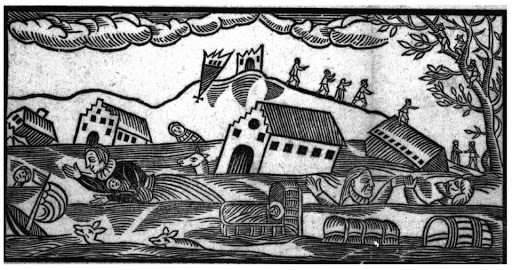
1454 the Great Govan Flood
On the 25th and 26th November 1454, the entire town of Govan was put “in ane flote” by “ane richt gret spait”. Every inhabitant had to sit on the roofs of their “houssis, bernis, and millis” as the flood swept them away.
Sources;
So Fair and Foul a Day, A history of Scotland’s Weather and Climate, Alastair Dawson, 2009, Birlinn Books
The Great Moray Floods of 1829, Sir Thomas Dick Lauder, reprinted 1998,Moray Books.
Rising from the Waves: The Development of the Historic Burgh of Perth
Chalmers’ Caledonia, Vol. III, provides a description of the Govan flood.
 Jean w Duncan